
What a Lakewood Resident Lookup Can Answer
Match the record to the question, not the name. A parcel result shows an owner or a mailing destination. A docket row shows a scheduled hearing. A vital application leads to a certificate only for an eligible requester. A directory entry places a household in an earlier year. The coverage table keeps these products apart.
| Record | What it confirms or locates | Where | Access limit |
|---|---|---|---|
| Assessor parcel | Owner, mailing, situs, parcel and building lead | Jefferson County Property Records | Not occupancy or title certification |
| Recorded deed | Grantor, grantee, legal transfer and instrument | Jefferson County Recorder | Recorded event, not current resident proof |
| Court docket | Scheduled hearing, party and case clue | Colorado Judicial | Not the complete case file |
| Voter lookup | Individual registration or ballot-status lead | Colorado Go Vote | Exact fields, protected and under-18 omissions |
| Vital record | Birth or death event if access is eligible | Jeffco or state Vital Records | Confidential, ID and relationship rules |
| Business or license | Entity, credential, status or filing affiliation | Colorado SOS or DORA | Not a personal residence finding |
| Directory or archive | Historical name, address, household, church or place lead | DPL, JCPL, Heritage, Archives | Year, locality and collection limits |
A careful Lakewood resident lookup records the match and the doubt together. Two independent identifiers work best. Pair a legal description with a name, or a case number with a date.
Lakewood Resident Names and Parcels
Begin with the Jefferson County owner search when a name may connect to land. Enter Last Name and First Name. Note the result maximum and access date. Then open the parcel detail. Compare the owner spelling and the PIN or AIN. Check the situs address, the mailing address, the subdivision, and any sales or reception leads. Then confirm the legal instrument with the Recorder.
Mailing and situs addresses are not the same thing. A mailing destination can point to another city, state, representative, or entity. The owner field is an assessor attribute, not proof that anyone lives there. A resident lookup that needs a current registration can turn to Go Vote. But a no-match may come from spelling, a former ZIP, a protected address, or an under-18 record.
- Write the name as found and keep likely spelling variants separate.
- Compare the parcel’s legal description or reception lead with the Recorder index.
- Use the address, date, and source notice to decide whether a second record is relevant.
Lakewood Court Lookup Fields
The Colorado Judicial Jefferson County docket portal is a useful name-search lead. But a docket is not a case file. At least one filter beyond date is required. The form allows a judicial district, county, courthouse, and court type. It also takes division, date range, case year, case class, case sequence, party, and attorney. A party can be an individual or a business. An attorney can be a name or a bar number.
| Location | First Judicial District, Jefferson County, Jefferson Combined Court. |
|---|---|
| Date | Today, one week, one month, three months, six months, or a specific date. |
| Case route | Four-digit case year, class such as C, CR, CV, DR, PR, or other official choices, and sequence. |
| Name route | Individual first and last name, business name, or attorney name and bar number. |
| Output | Date, time, duration, uppercase party or business, case number, hearing type, location, courtroom, and appearance type. |
Read a result as a scheduled event, nothing more. A docket row may omit the complaint, judgment, exhibits, disposition, protected address, or sealed material. The Jefferson docket search is handy for finding a case number and the originating court.
Request a Lakewood Court Record
A docket is not always enough. Use the Colorado Judicial record-document request route or the Jefferson County Clerk of Court. The web form asks for contact details, case number, case type, year, county, and party. It also asks for date of birth if relevant. The copy type matters too. Choose a regular, certified, or exemplified copy. The records counter keeps hours Monday through Thursday from noon to 4. The main office runs on a different schedule.
The office lists a three-business-day target unless circumstances extend it. Listed charges include $0.25 per page and a $5 name search. Certification costs $20. A transcript judgment costs $25. Research or redaction runs $30 per hour after the first hour. Confirm the current amount before sending money. Juvenile, adoption, sealed, protected, and victim-related records carry narrower access.
- Docket
- A schedule or case index entry showing an event, not the whole file.
- Disposition
- The court’s stated outcome for a proceeding or charge when released.
- Certified copy
- A copy formally authenticated by the custodian for an accepted purpose.
- Index versus image
- An index helps find a document; an image or certified copy is a different product.
A case in Lakewood Municipal Court works differently. Its portal states that public actions, dispositions, sentences, and orders can be requested, but case information cannot be viewed online. Requests go through the portal, in person, or by mail.
Lakewood Voter Lookup Limits
The individual Colorado Go Vote lookup asks for First, Last, ZIP, and Birthday. Its instructions say to use exact registration spelling. They say to try a former or last ZIP after a move. They also say to contact the county clerk if the record is not found. The result is a single registration confirmation or ballot-status lead. It is not a public street or block roster.
Colorado voter products follow separate request and use rules. The statewide data request form names product codes, requestor information, delivery, payment, and election-cycle restrictions. It also protects confidential addresses and limits use. Never turn an individual result into a published address list.
Lakewood Vital Records Access
Jefferson County Vital Records issues Colorado birth and death certificates at its Golden office. The Colorado Department of Public Health and Environment handles the statewide route. Birth and death records are confidential under C.R.S. §25-2-117. Current applications ask for requester identity, relationship or direct interest, identification, proof, and payment. Local forms list $25 for the first certificate and $20 for each additional copy.
The death application describes a genealogical-use route. It covers records older than 25 years with proof. That rule does not extend to every birth or marriage record. Marriage licenses and their index sit with the Clerk & Recorder. Divorce files belong to the court. A newspaper, cemetery, church, or genealogy result can supply a lead, never a replacement certificate.
The Colorado Vital Records page explains the state routes and the confidentiality context.
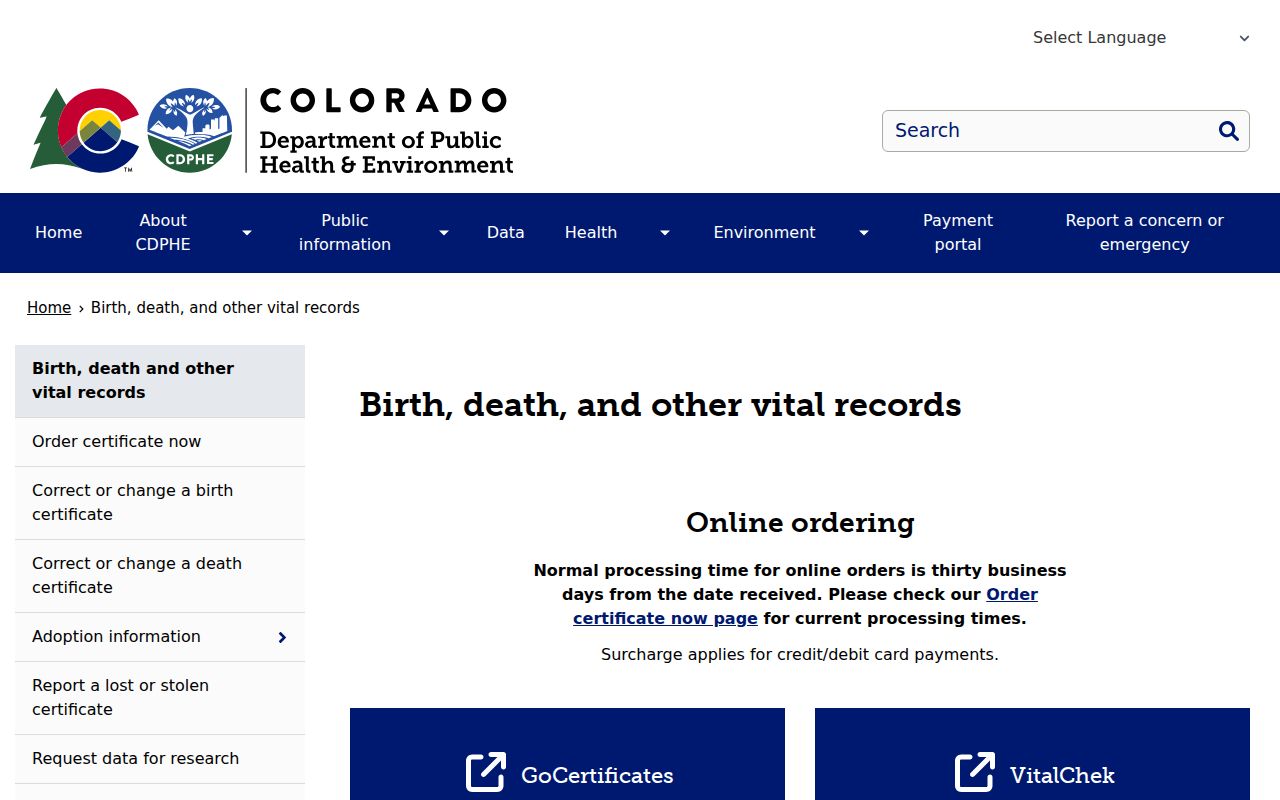
Note: the vital-record image shows that a name search and an eligible certificate request remain two separate steps.
Lakewood Custody Record Limits
Custody tools answer narrow questions. The Jefferson County Sheriff lookup covers current inmates by last name, first name, and booking date, refreshing about every 15 minutes. The Colorado DOC locator uses a DOC number, last name, first name, gender, and a CAPTCHA. The CBI registry updates hourly, with search and map routes, and it excludes some categories, including juvenile and misdemeanor-only matters. The BOP locator covers federal custody from 1982 forward. NARA remains the route to earlier federal records.
| Source | Displayed scope | Limit to retain |
|---|---|---|
| Jeffco Sheriff | Current inmate and booking fields | Former records go through the Records Unit; identity warnings apply. |
| Colorado DOC | State custody locator | Search form and historical coverage are limited. |
| CBI registry | Defined registry categories and map/search | Not a complete history; local agencies may hold more. |
| BOP | Federal custody, 1982 forward | Pre-1982 material routes to NARA. |
Log the agency, search date, update note, spelling, and displayed status. One match in a custody product cannot identify every record belonging to that person.
Lakewood Resident License Records
Colorado's Secretary of State business database searches business, trade, trademark, ID, and document fields. Advanced search adds filing dates, registered-agent names, trade-name registrants, trademark registrants, and individual exact-match fields. A detail record can show status, formation, jurisdiction, principal office, registered agent, filing history, and trade names.
DORA takes another route. Its verification search covers profession, first, middle, and last name, license type, number, status, wildcard, or facility. A result can corroborate a credential. An entity, registered agent, licensee, applicant, and address are different roles, so keep them distinct in a Lakewood resident lookup.
The fields come from one place. The Colorado DORA verification portal is that source.
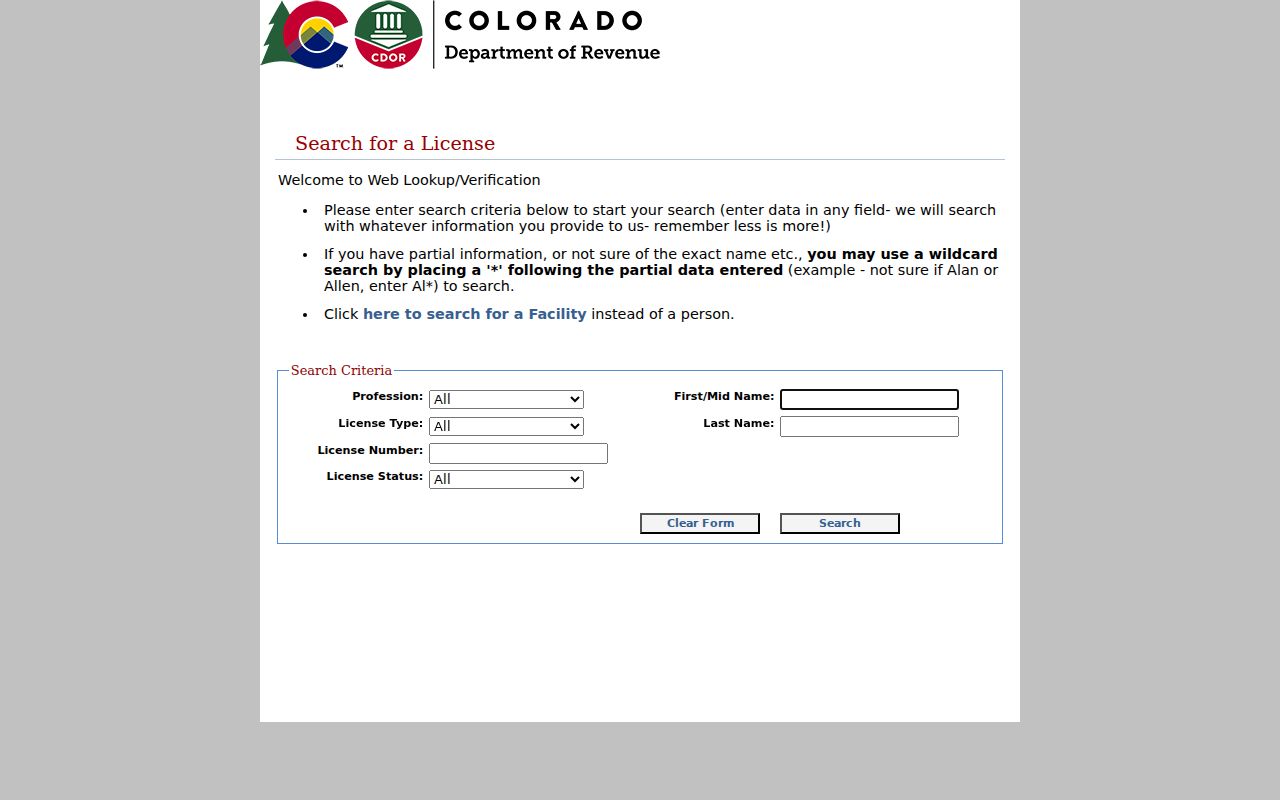
A license image checks affiliation; the assessor and Recorder keep the property trail.
Lakewood Historical Resident Sources
Lakewood history spreads across many shelves. DPL city directories and Criss-Cross, JCPL obituary and newspaper databases, census schedules, the Green Mountain Presbyterian register, cemetery collections, probate, naturalization, Heritage Lakewood metadata, and Jeffco Archives all play a part. FamilySearch lists Colorado marriage, divorce, census, church, military, cemetery, and naturalization collections, with image restrictions that vary. State Archives aids describe Jefferson probate and naturalization series. A finding aid is not a name index.
The Lakewood city directory collections page holds the directory years and the reading method. Tie each historical name to a volume, page, collection code, date, or archive reference. Then pair that dated entry with a second source. Only then treat the person-place link as sound.
A careful resident lookup ends when the source can no longer answer the stated question.
Lakewood Same-Name Lookup Checks
Treat a same-name result as a candidate. Require two identifiers where lawfully available, such as a parcel legal description with a reception number, or a case number with a hearing date. Preserve spelling variants. Sharing a surname, ZIP, business type, or city is never grounds to merge two people into one. When a record is missing, keep the search scope rather than calling the person absent.
Some gaps are intentional. Colorado's Address Confidentiality Program, protected voter addresses, vital-record rules, DMV restrictions, and juvenile, sealed, adoption, victim, and ongoing-investigation limits can all close a record. A utility account is not a public resident field. If a source is wrong, contact the originating custodian with the record identifier. Never publish a correct and incorrect name as one.
- Save the portal URL, access date, exact spelling, filters, result count, and notice.
- Separate an owner, occupant, registrant, party, licensee, applicant, and historical householder.
- Stop when the next record would require protected data or an unsupported inference.
Lawful use. A Lakewood resident lookup is for personal, family-history, civic, and place research. Do not use a name trail to stalk, harass, intimidate, or harm anyone.