
Sources for Lakewood Previous Residents
Different sources cover different eras and different relationships to an address. The Recorder shows legal instruments. A directory points to a householder or subscriber. A census describes a household at a federal enumeration date. An appraisal photograph shows a structure, not every person inside it. Start with the row that fits the period and question.
| Source | Years it covers | Where held | What it shows |
|---|---|---|---|
| Recorder real-estate images | From 1859 stated | Jeffco land portal and Recorder | Deeds, liens, plats, declarations, and instruments |
| Assessor current and sales | Current; historical span not stated | Jeffco Property Records | Owner, mailing, parcel, building, and sales lead |
| Householder and Criss-Cross | 1924 to 2018; digital 1924 to 1937 | DPL | Address-to-householder or occupant lead |
| City directories | Microfilm 1866 to 1981; digital Denver 1873 to 1923; selected Polk volumes | DPL and Ancestry | Name, address, occupation, and household notes |
| Lakewood telephone books | 1995/96 through June 2009 index | DPL STX-2 | Subscriber, address, and phone fields as held |
| Federal census | Public release through 1950 under the 72-year rule | Census, JCPL, FamilySearch | Household and place facts at an enumeration date |
| Tax, permits, and appraisal photos | Series-specific | Jeffco Archives, Lakewood, eTRAKiT | Owner, value, structure, project, and date leads |
| Heritage photos and oral histories | Selected online; 2026 catalog | Heritage Lakewood | Place, structure, person context, and image metadata |
Coverage is asymmetrical. A source can begin early but have missing volumes, a different locality, or a restricted image. Note the gap instead of filling it with a modern assumption.
Lakewood Resident Parcel Card
Open the Jefferson County Property Records Search with the current address. Save PIN or schedule, AIN or parcel, owner, situs, mailing address, subdivision, neighborhood, property class, building facts, and sales or reception clues. The legal description and subdivision or block and lot fields are the bridge to older instruments. The parcel card is the anchor for previous residents.
A parcel card is a starting point. The owner field can be an entity or a legal interest. The mailing field can point to another city or state. The county’s Assessor guidance warns that sales history may show recent deed or reception clues, but the Assessor does not provide a chain of title. Use the Clerk & Recorder for recorded documents.
- Situs
- The physical location of the parcel.
- Legal description
- The recorded land description, such as a subdivision lot or metes-and-bounds text.
- Reception number
- A county identifier for a recorded instrument or filing.
- Chain of title
- A connected sequence of recorded transfers and interests, not an assessor summary.
Lakewood Record Sales History
Sales history can point toward a deed, but it should not be treated as the deed chain itself. Record the displayed sale date, reception clue, party spelling, and parcel identifier. Then use those terms in the Recorder’s Real Estate Index. Compare the recorded legal description with the current parcel, because a street address can change while the land description stays stable.
Tax delinquency, foreclosure, permit, or code records are also dated events. A foreclosure file can remain viewable when it is cured or withdrawn. A permit can show a project or applicant. Neither proves a completed transfer or a current occupant. The source’s event status belongs in the house-history note.
Lakewood Recorder Records Search
The Jefferson County Real Estate Index uses a General Search and Combined Name Search route. Enter a party in Last Name, First Name format, choose Party Type, and search possible grantee and grantor variants. Capture grantor, grantee, role, reception or instrument number, recording date, document type, legal description, prior reference, parcel cross-reference, and image or payment status when shown.
Jefferson County states that scanned real-estate images are available online from 1859 forward. Exact instrument and image coverage beyond that statement was not located. If an image or year is absent, ask the Recorder about the defined document, date, reception range, or office copy route. Recording staff can receive mail documents at 100 Jefferson County Parkway, Suite 2560, Golden, with payment, return address, and phone.
Search the current grantee first. Then search that grantor as a grantee to move backward. Keep names of entities and people separate. A document that matches only a surname is a candidate, not a chain link.
Lakewood Resident Deed Chain
The backward search is a repeated handoff from one recorded party to the next. It connects the current parcel to older owners without claiming that an owner was also an occupant.
- Resolve the current address to PIN, AIN, parcel, legal description, subdivision, block, and lot.
- Use the current owner and sales or reception clue to find the purchase instrument.
- Capture the grantee, grantor, recording date, instrument type, legal description, and prior reference.
- Search the seller as a grantee and compare the legal description before moving to the next instrument.
- Bridge gaps with plat, tax, foreclosure, probate, permit, map, or archive records, and mark each confidence level.
The Jefferson County Recording page supplies the office, mail, and large-format plat route. The online portal is a finding tool. A certified or official copy is a separate request.
Lakewood Resident Households in Directories
Ownership is only half of previous-resident research. DPL Householder and Criss-Cross volumes lead from address to householder or occupant. City directories add names, addresses, occupations, spouses, forwarding notes, and nearby entries. The directory collection page explains the years and locality cautions; it is better to link there than to repeat every shelf detail here.
For previous residents, start with the house number and street. Read the front matter and abbreviation key. Check the prior and next year, then compare the street section with a census or deed. If the book lists Denver area or another locality, preserve that label. A directory entry is a dated lead, not a certified occupancy record.
The Lakewood city directory collections page handles the volumes themselves, while the backward trail follows one address.
Lakewood Records for Census and Tax
Federal census schedules provide household and place facts at an enumeration date. JCPL, HeritageQuest, Ancestry, and FamilySearch offer different access paths. Jeffco Archives catalogs tax and assessment material back to 1859, and an archive description places appraisal photos as early as 1949. A photograph can show a structure and its setting; a tax roll can show an owner or legal description. Together they can bridge a directory gap.
Keep the census geography honest. An old county, township, or settlement label is not automatically the modern Lakewood boundary. Pair the name, address, household members, age or place detail when lawfully available, and property description. An obituary or probate record can close a life-history trail, but it should not be used to infer a living person’s address.
The DPL building-history guide shows how directories, criss-cross volumes, Sanborn maps, permits, ownership, and one-property research fit together.
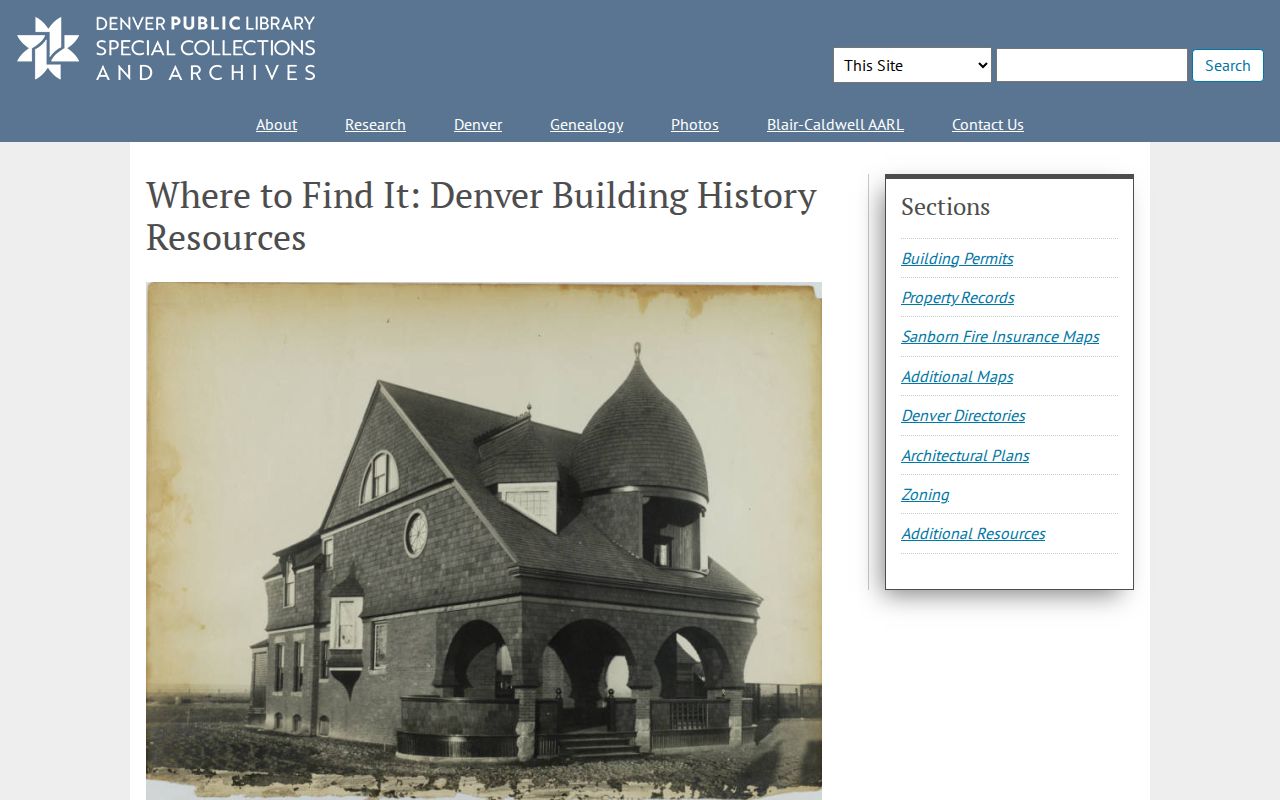
The guide image belongs with the corroboration step because a house history gains strength from several dated source types.
Lakewood House History Support
DPL describes one-property research as a service that can take two to four weeks and may use legal descriptions, ownership, permits, photographs, and plans when available. DPL is Denver-centric, so ask whether a Lakewood parcel is covered before relying on a stated run. Heritage Lakewood staff can bridge an object, photograph, oral history, provenance note, or related repository. Jeffco Archives can route a request for a specific tax roll, map, assessment series, or photograph.
Use a narrow email, phone, mail, or appointment request. Name the parcel, modern address, older address, date span, collection, and desired format. A general request for everything about a person is harder to search and can invite a false sense of completeness.
Lakewood Record Gaps in Sanborn Maps
DPL’s documented Sanborn holdings include Denver 1887, 1890 to 1893, 1903 to 1904 pasteovers through 1925, 1929 to 1930 through 1961, 1962, and an incomplete 1974 set. Exact Lakewood sheet coverage was not located. Use those dates as a Denver collection lead, not as a promise that a Lakewood building appears.
A Sanborn sheet can show building footprint and use. It does not name every household. Pair it with a plat, eGIS parcel, deed, tax roll, directory, appraisal photo, or Heritage record. If a map seems to place a building at a different address, preserve both the sheet label and the current parcel identifiers.
Lakewood Street Record Continuity
Jefferson County’s historical material says wooden street signs were replaced with metal signs in 1952. That can help date a photograph or map, but it is not proof of a citywide renumbering. No official Lakewood-wide street renaming, readdressing, or annexation list was located. Bridge an old address with the current assessor and eGIS record, legal description, plat, deed, directory, and historical map.
ZIP codes can also mislead a backward trail. Modern ZIP geography did not exist in the older directory eras. Search by locality, rural route, street, township, or telephone exchange, then use the parcel and legal description to test continuity. Previous residents should be attached to a dated address record, not just a modern label.
Lakewood Past Residents and Safe Use
Previous residents can include owners, occupants, boarders, subscribers, church members, or people named in a newspaper. The sources do not carry the same meaning. A deed establishes a recorded interest. A directory gives a printed lead. A census supplies a historical household snapshot. A church register shows a membership or communicant entry. State and county archives may hold probate or naturalization papers. Label the role and date every time.
Protected voter and Address Confidentiality Program records, DMV information, utility accounts, juvenile and sealed cases, restricted vital data, and private membership lists stay outside a public house-history trail. The best record is not always the most personal one. When a source has a gap, cite the gap and ask the custodian rather than triangulating an address. Any conclusion about previous residents needs a dated source and a stated role.
Lawful use. Research into Lakewood previous residents is for house history, family history, civic records, and place history. Do not use it to stalk, harass, intimidate, or harm anyone.